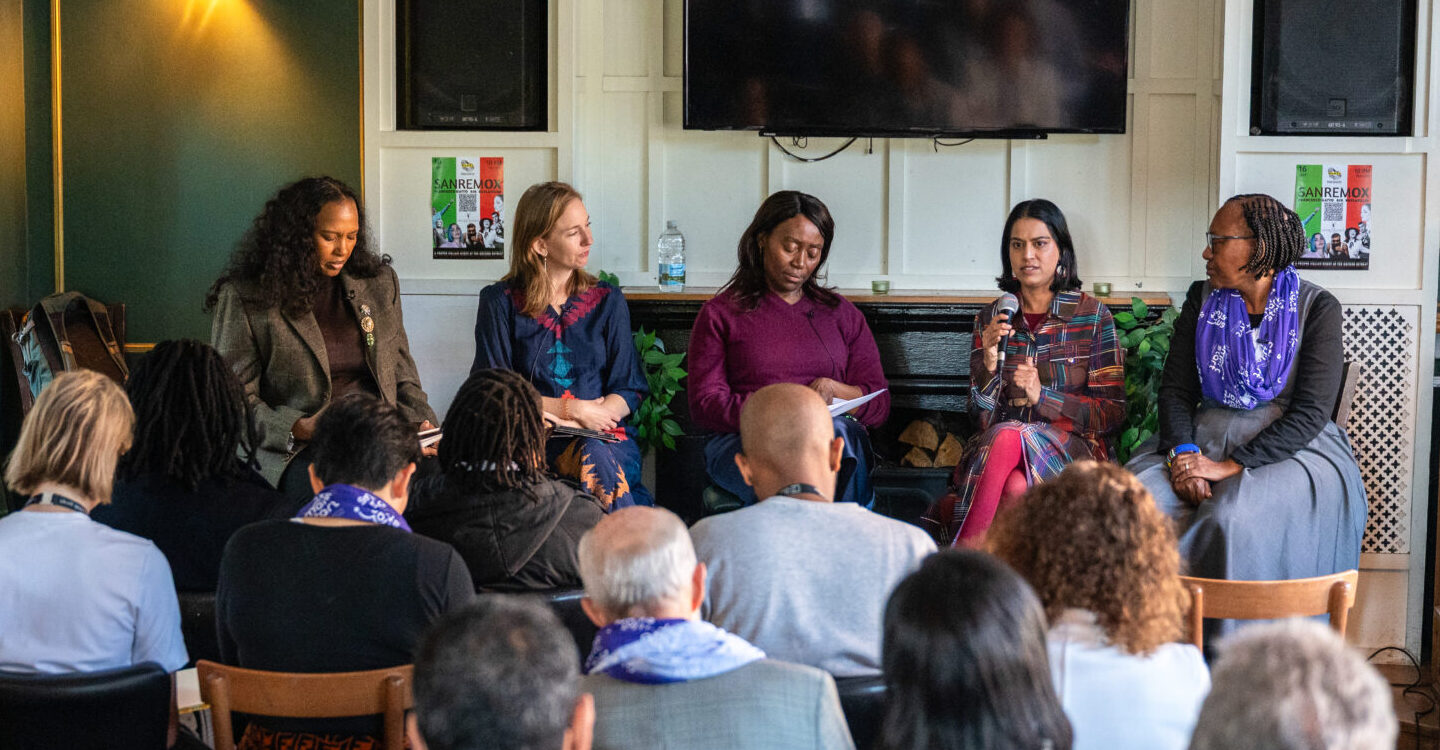
The panellists from left to right: Kulula Manona, Chief Director for Foundations for Learning at the Department of Basic Education; Tess Peacock, Executive Director of the Equality Collective; Awo Ablo, President of Co-Impact; Zaheera Mohamed, CEO of Ilifa Labantwana; and Grace Matlaphe, CEO of SmartStart
A decade ago, South Africa’s early childhood development (ECD) sector was characterised by fragmentation, invisibility, and chronic underfunding. The system was designed for formal provision, leaving countless women-run programmes in informal settings unable to register — or even appear on government’s radar. There was little data, little accountability, and a “welfare mindset” that treated ECD as care for children in need, rather than a universal right for all children.
That picture has changed. Partnerships have been built to bridge the gap between the public and private sectors, new delivery models have been tested and scaled, and data systems have been built.
Earlier this year at the Skoll World Forum 2026, five organisations gathered on the margins of Oxford’s most prominent social innovation forum to take stock of how this systemic shift has actually happened, and what it will take to sustain it.
The panel included Zaheera Mohamed, CEO of Ilifa Labantwana; Grace Matlaphe, CEO of SmartStart; Tess Peacock, Executive Director of the Equality Collective – three organisations that have taken a systemic approach to improving the gaps in the ECD ecosystem. The panel also included Kulula Manona, Chief Director for Foundations for Learning at the Department of Basic Education, and was moderated by Awo Ablo, President of Co-Impact, a global philanthropic collaborative supporting large-scale change in South Africa’s ECD ecosystem. Closing remarks were given by David Harrison, CEO of South African philanthropy organisation, DG Murray Trust.
Central to the conversation was the 2022 function shift — the transfer of the ECD portfolio from the Department of Social Development to the Department of Basic Education (DBE). Though it took a full decade after being first recommended, the shift proved to be a rare inflection point. It opened a window for the entire ecosystem to reflect, question inherited assumptions, and make clear, coordinated demands of government, while, crucially, also developing solutions to some of the sector’s most pressing challenges.
The DBE inherited a system with significant data gaps and uneven quality, but also remarkable human infrastructure. “We received tons of talent and a community infrastructure that comes in the form of the women who have been running early learning programs. So, we knew in the midst of the gloom there was something we could build with,” said Kulula. A key priority became making these providers visible. The development of eCares — a digital registration and administration system — gave the sector something it had never had: reliable data. That data, in turn, became the foundation for population-based decision-making and strengthened the case for increased public investment. By providing National Treasury with greater confidence in the size, reach, and administration of funding to the sector, it helped unlock additional funding for ECD and will ideally improve the state’s ability to direct resources where they were most needed.
Panellists described three interlocking roles that proved essential: Ilifa Labantwana focused on strengthening public systems — regulatory, quality, and financing — so that government could play an enabling rather than purely delivering role. “Government’s role is to create a public system that recognises ECD practitioners, meets them where they are, and builds them up to where they need to be in terms of the quality,” said Zaheera.
SmartStart focused on closing supply gaps in underserved communities to reach excluded children by identifying and supporting women as ECD practitioners, reframing them as agents of change in their communities. Equality Collective’s Real Reform for ECD coalition built a national movement of over 300 organisations and thousands of ECD practitioners, centering practitioner voices in advocacy and applying strategic, sustained pressure to create an enabling legal and policy environment for universal access. At the same time, the coalition provided technical support to government on key reforms, including the drafting of amendments to the legislation.
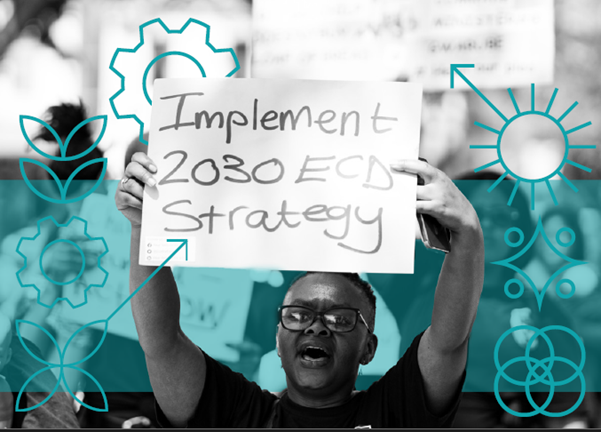
The results have been significant. A national 2030 ECD Strategy has been published. The President has made young children a consistent political priority. And in a landmark moment, in 2025, the National Treasury allocated an additional R10 billion — roughly half a billion US dollars — which would allow approximately 100,000 more children to access subsidised early childhood development (ECD) services. This shift was made possible by compelling data and years of relationship-building across government, civil society, and the private sector.
“Over the past 5 years, the entire ECD ecosystem has questioned our stale and ineffective ways of working and realised that when we come together for impact, we can really create meaningful things,” said Kulula. “It started with us simply asking the sector, what is it that you want from government? And they were very clear: Open the door. That was one message that we’ve got from all kinds of directions. Open the door.”
Philanthropy played a catalytic role by supporting innovation, testing, and collaboration over the long-term, and focusing on building strong, sustainable systems over immediate, visible results.
“We were founded by a group of funders who felt that they wanted to create a more sustainable system to invest into,” said Grace, “What that did is give us such a powerful space to think deeply about the problem we’re trying to solve, stay committed to the problem, rather than being divided between accountability to a funder and the problem you’re trying to solve.”
What emerged from the discussion was a set of lessons for systems change that can be applied across sectors and geographies:
- Systems were built on the existing value within communities – the enterprising women who run early learning programmes.
- Government and non-government partners worked together to strengthen public systems for regulation, quality, and financing – made possible by government “open for business” attitude and collaborative approach.
- Law and regulation should be viewed as tools for inclusion and system-building, not simply compliance mechanisms. In South Africa’s ECD sector, progress accelerated when stakeholders shifted from seeing regulation as a barrier to recognising its potential to create flexible pathways into the formal system.
- Funders and partners need to be “restless patient investors,” committed to incremental, deliberate systems work that achieves long-term change.