The following story is extracted from our 2025 Annual Report, highlighting how we worked with municipalities, government partners, and practitioner-led movements to strengthen local systems that support young children and expand the integration of ECD into planning, budgeting, and regulatory processes. To read the full report, click here.
Working with municipalities is the last mile of systems change. Local government is the sphere closest to children and service providers, and it also acts as the primary gatekeeper for infrastructure, health, safety, and land-use regulations. However, municipalities’ constitutional autonomy makes scaling work difficult.
In the past year, we made considerable inroads towards ECD being considered in local government planning processes and regulatory frameworks.
Getting ECD onto municipal agendas
A 2025 review of the Integrated Development Plans (IDPs) in eight municipalities showed progression from general recognition of ECD to clearer projects, improved data use, ward-level prioritisation, and longer-term planning, though progress was uneven. This has been driven by:
- Higher-quality and greater quantity of ECD practitioners’ engagement in local government processes.
- Local government’s increased appetite for engagement.
Driving local change through partnerships
This work is largely driven by our partner Equality Collective and the grassroots movement for ELP practitioners we support together, Real Reform for ECD. Over the past five years, Equality Collective and Real Reform have steadily and consistently nurtured these eight constituencies by building relationships and trust with local government officials, as well as practitioners’ capacity and confidence to engage in the various municipal processes.
Lessons in changing processes and practices at the local government level centre on:
- Establishing and maintaining trust.
- Building collective pride and cohesion within groups.
- Remaining focused on a common vision of better outcomes for children.
Supporting practitioner agency
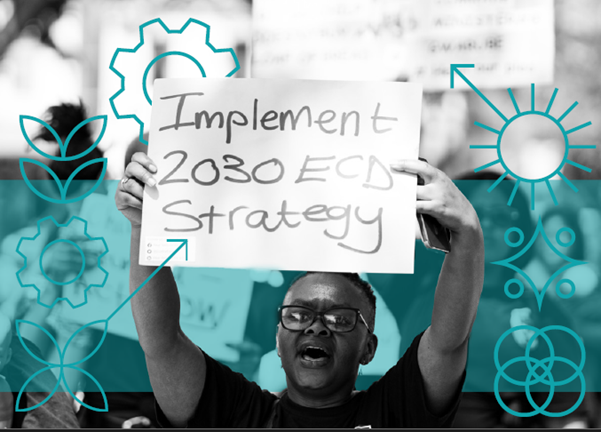
Our work with Real Reform for ECD has also shifted an important mental model about who has the agency to demand legislative change. ELP practitioners tend to be under-resourced, underappreciated, and undervalued in South African society, despite the transformative power they hold in children’s lives and in their communities.
The Real Reform for ECD Movement was founded to harness this power for change. However, despite demonstrating their collective power in overturning the unjust Children’s Act revision in 2022, Real Reform for ECD found it difficult to shift ELP practitioners’ own perceptions of their limited agency.
Real Reform has spent years building out the inherent agency of practitioners and producing high-quality capacity-building products, including templates for input into IDPs; toolkits; videos; webinars; in-person coaching.
The consistency has paid off. Real Reform members are capable and confident enough to engage directly with ward councillors and government officials and do so. The 2025 review proves that their inputs are filtering through to planning, budgeting, and decision-making at the local level.
Scaling functional ECD processes
We have found that macro legal and policy work, coupled with localised support and partnership building, can result in effective and pragmatic scale-out of functional ECD processes at the local government level.
With the Ministry for Cooperative Governance and Traditional Affairs (CoGTA), our partner Kago Ya Bana facilitated the drafting of municipal guidelines and case studies on municipal best practice to prioritise ECD.
The guidelines have been signed by the DBE minister and await final sign-off from the CoGTA Minister. They introduce a strong directive from CoGTA to incorporate ECD IDP indicators in municipal planning and are well-timed to support advocacy to cascade ECD priorities into election manifestos ahead of the 2026 local government elections.
The elections are also an opportunity to test and improve our understanding of what works to create impact at local government.
Following the elections, in partnership with the South African Local Government Association, CoGTA will champion the inclusion of ECD indicators in the IDP template, to be rolled out nationwide.
Unlocking municipal compliance for ELPs
The Bana Pele PMU has also adopted an increased focus on local government, with the understanding that multiple departments and partners need to work together to unlock blockages ELPs face in obtaining municipal compliance.
The PMU Local Government Workstream is strengthening the working relationship between municipalities and DBE districts by bringing Environmental Health Practitioners closer into the process and promoting intergovernmental collaboration. The goal is to encourage a more developmental approach to compliance and improve pathways to compliance for ELPs.